

The King Has One More Move
Men’s Health Week runs June 15 to 21. This is also the month most countries celebrate Father's Day. Stay strong.

In 1861, Paul Morphy is a dinner guest at the home of Reverend R.R. Harrison in Richmond, Virginia. After supper, he finds himself in front of a painting.
“Checkmate” by German artist Moritz Retzsch shows a young man sitting across a chessboard from the Devil himself. The young man’s position looks completely hopeless. The Devil’s pieces dominate the board. The young man’s face says he knows it. Everyone in the room has already accepted the verdict.
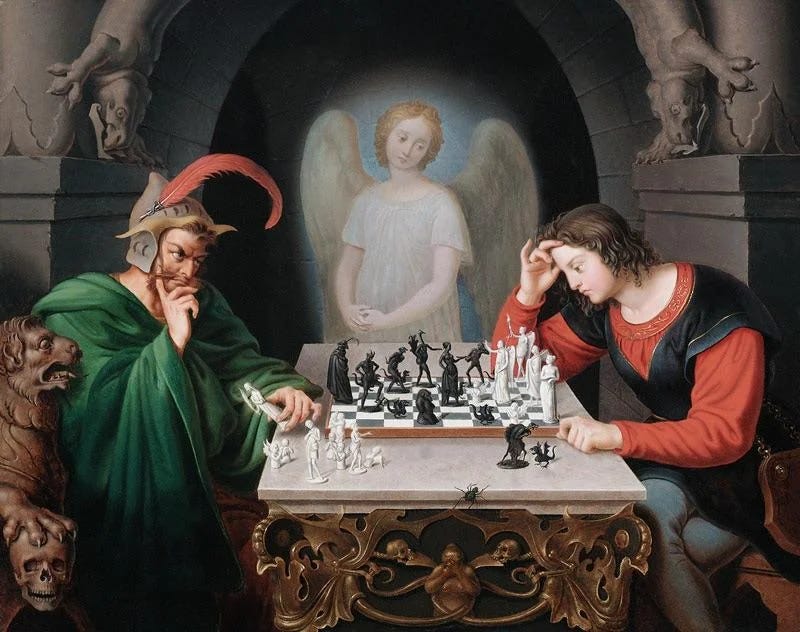
Morphy studies the board quietly. Then he turns to his host and says, modestly: “I think I can take the young man’s game and win.”
The room pushes back. “Not even you, Mr. Morphy, can retrieve that game.”
He replies: “Suppose we place the men and try.”
They set up the pieces on a real board. Morphy takes the young man’s position, plays against each gentleman in succession, and wins every time.
The position on the board hadn’t changed. What changed was who was looking at it.
I’ve been thinking about that painting in a different context.
There’s a quote that gets passed around in men’s mental health spaces. Nobody seems to know exactly where it originated, but it moves because it says something true that most people don’t say out loud:
“One of the saddest things in the world that nobody talks about is how the only reason a lot of guys are still alive is so the people they love and care about won’t have a dead Father, Brother, Son or Friend.”
A man surviving on that reason alone has accepted that the game is over for himself. He’s made his peace with the verdict. He’s not at the table because he sees a way forward. He’s there because leaving would wreck everyone else.
And yet. He’s still at the table. He’s still making a move. He just doesn’t see it that way.
The young man in the painting has the same expression. Resigned. Certain the outcome is decided. The Devil across from him looks confident, and why wouldn’t he? The crowd agrees. The painting is literally called “Checkmate.” The composition is built to tell you it’s over.
What nobody in that room had done, and what Morphy understood immediately, is that the position had been read, not analyzed. There’s a difference.
Reading the position means taking in the visual, the emotional frame, the consensus in the room. The young man’s face says defeat. The title says defeat. Every reaction in the room says defeat. Case closed.
Analyzing the position means actually placing the pieces on a board and asking: are there moves here that nobody has found yet?
There were. There always were. Nobody had looked.
Men in real pain are extraordinarily good at presenting something that reads as fine. They pick up on what the room can handle, they calibrate accordingly, and they stay functional enough that nobody thinks to look closer. The crowd in Harrison’s drawing room accepted the frame of the painting. The people around a man who is barely holding on accept the frame he’s presenting. Both crowds have done exactly the same thing: read the situation and concluded the game is over, and never moved a single piece.
The problem usually isn’t that people don’t care. It’s that nobody has sat down and actually looked.
And men don’t ask for that. They’ve been told, in a thousand different ways, that asking for that is weakness. That the pieces are theirs to manage. That the position is their problem to solve alone. So they sit across from the Devil, they look at the board, and they decide that everyone in the room is right. It’s over. The best they can do now is stay at the table long enough that the people they love don’t have to carry the other thing. That’s not nothing. Staying at the table is a move. But it shouldn’t be the only one available.
What Morphy had wasn’t optimism. He didn’t stand in front of that painting full of belief that everything would work out. He was a chess master who had spent decades training himself to see what was actually on the board rather than what the emotional frame suggested. He looked past the resigned expression, the triumphant Devil, the title, the consensus, and asked a simpler question: are there moves here?
That question is available to anyone. It doesn’t require confidence that things will get better. It doesn’t require certainty about the outcome. It requires only the refusal to accept the verdict before you’ve looked.
If you’re the young man at the board right now: the frame around you is not the position. The fact that everyone around you has accepted it doesn’t make it true. The game hasn’t been analyzed. It’s been read.
If someone in your life is that young man: you probably haven’t placed the pieces on the board. You’ve read what they’re showing you, which is not the same thing as seeing what’s actually there. Placing the pieces means asking the harder question. The one that takes longer and has a less comfortable answer.
The king always has one more move. Until it doesn’t.
And even then, you might be wrong about when “doesn’t” starts.
Morphy didn’t promise the young man would win. He demonstrated that moves existed and then played them, one at a time. That was enough to start.
“Not even you, Mr. Morphy, can retrieve that game.”
He didn’t argue. He placed the pieces and started playing.
That’s not hope. That’s refusal. And sometimes that’s the only move that matters.
The king always has one more move. Until it doesn’t. And even then, you might be wrong about when “doesn’t” starts.
Men's mental health doesn't get the same airtime as everything else, and men pay for that gap. If someone in your life is at the board and you're not sure what you're actually looking at, asking directly is not the wrong move. Talking is a move.
If you or someone you know is in crisis, find your country’s crisis line at findahelpline.com
The story of Paul Morphy and the Retzsch painting was first published in the Columbia Chess Chronicle in August 1888, confirmed by eyewitness Reverend R.R. Harrison. The popular version placing the encounter at the Louvre has no documented source. The chess position in the painting is disputed among analysts; some argue it is a losing position for white regardless of the move. What is not disputed is that nobody in the room had placed the pieces on the board.